Smart City Expo World Congress:
Bridging the Gap Between Science and the City
Smart City Expo World Congress transforms scientific knowledge into urban action. We provide researchers and academics a premier global stage to validate their work, influence policy, and forge partnerships with industry and city leaders.
Bringing Research to the Heart of Urban Decision-Making
Cities are living laboratories. The decisions made today about mobility, energy, housing, and digital infrastructure will shape urban life for decades to come. Yet the complexity of these challenges demands more than good intentions or available technology: it demands rigorous, evidence-based knowledge.
State-of-the-art research coming from universities and research centers is not an academic exercise; it is the foundation upon which smarter cities are built. And increasingly, public decision-makers know it.
The demand for science-backed solutions has never been greater among city leaders navigating climate pressure, demographic change, and the rapid evolution of AI.

From Academic Insight to Citywide Action
For academic institutions working at the frontier of innovation, SCEWC offers an environment no campus seminar can replicate: direct access to the decision-makers who turn research into policy, infrastructure, and lived urban experience.
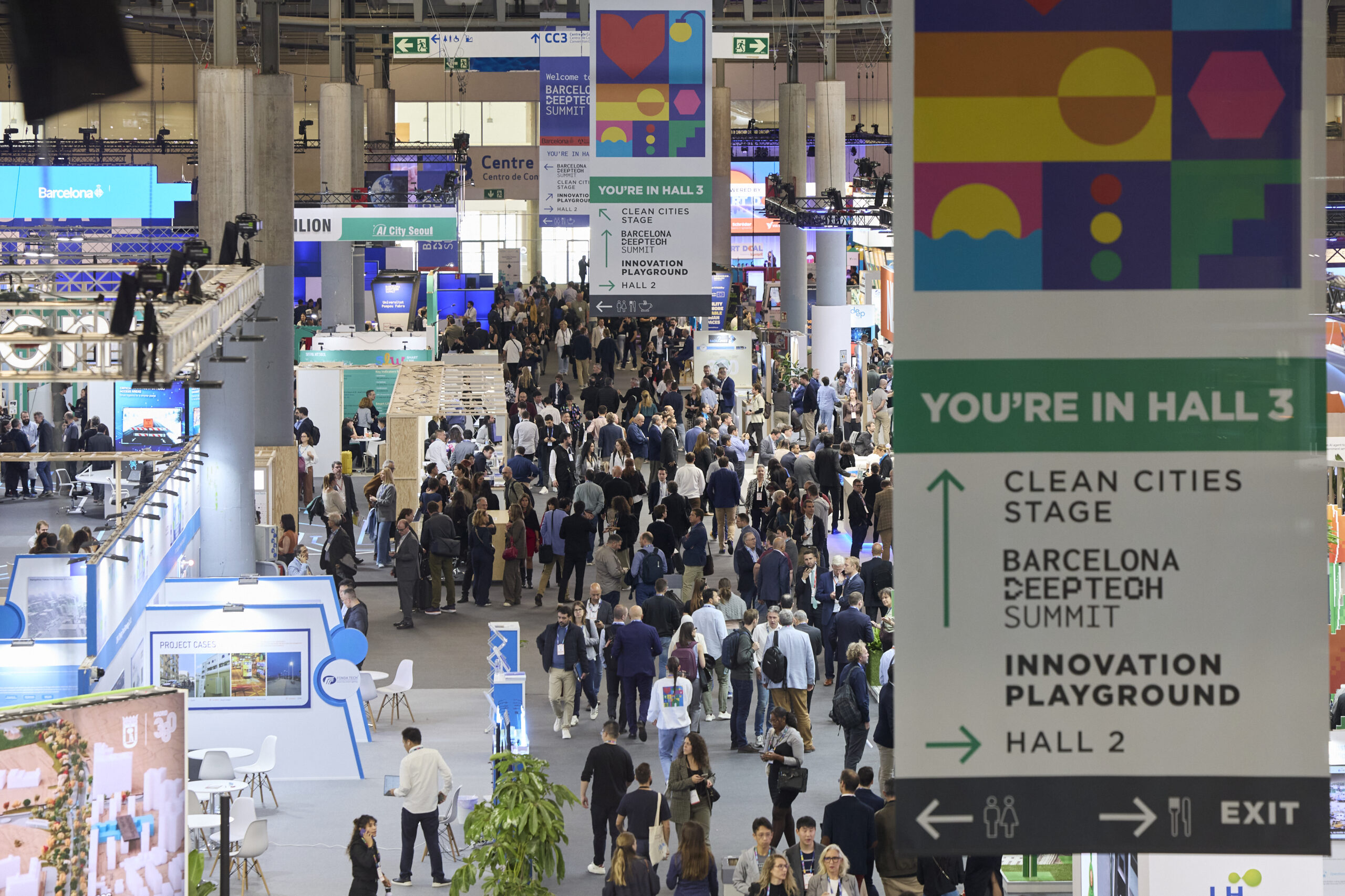
With over 1,000 cities and 1,100+ exhibitors converging in Barcelona each year, this is where research institutions connect with city leaders, technology companies, and institutional partners seeking scientific credibility and evidence‑based solutions.
High‑level research. Tomorrow's urban solutions
Taking research to the global urban stage
The distance between academic discovery and urban implementation has never been shorter — or more full of possibility. As AI, data governance, mobility, and climate resilience rewrite the rules of city management, researchers who position themselves at the intersection of knowledge and action will help shape the next generation of cities.
5 Nov | 09:15h - 10:20h
Innovation Playground Stage
5 Nov | 10:30h - 13:00h
Innovation Playground Stage
5 Nov | 13:10h - 14:10h
Innovation Playground Stage
Can Smart Cities use LLMs to improve interoperability and reduce software integration costs?
This session presents the work of two teams that used complex datasets from Porto Digital to design deterministic agentic data pipelines. They will share key lessons learned, discuss what makes public-sector AI trustworthy, and explore how these solutions can be scaled globally.
5 Nov | 14:20h - 15:05h
Innovation Playground Stage
Find out which research papers have been selected in 2026
- A Bio-Cultural Biomimetic Framework for Climate-Responsive Building Envelopes in Hot and Arid Environments: Integrating Biological Mechanisms and Saoura Vernacular Knowledge (Argelia)
- A Multi-Criteria, Risk-Informed Asset Integrity Framework for Power System Protection & Control Equipment: Bridging Reliability, Cybersecurity, Human Factors, and Lifecycle Economics (USA)
- A Municipal Digital Twin Simulator for Drone-Assisted Emergency Access in Rural Territories (Spain)
- AI-Enabled Remote Sensing for Smart Cities Covering from Hyperlocal to the Hypersky (Spain)
- Auditable Closed-Loop AI Agents for Urban Bridge Digital Twins (Japan)
- Augmenting Smart City Management through the Integration of Digital Twins with Fog Computing (Saudi Arabia)
- Challenges for Autonomous Mobility in Policing: Research from Dubai Police (United Arab Emirates)
- Citiverse: AI Sparrow as a Multispecies Participation Agent for Inclusive Urban Futures (Finland)
- Context-Aware Footfall Intelligence for Historic Districts Via Digital Twins: Per-Sensor Machine Learning and Spatio-Temporal Graph Networks in the Regen Project (Spain)
- Governing Agentic AI in Cities: Provenance-Enforced Decision Support for Water Infrastructure (South Korea)
- Indirect Prompt Injection in Municipal Document-Processing Copilots: Attacks, Defences and Harm: A representative proof-of-concept evaluation across four large language models (Spain)
- Infrastructure Project Delivery in Riyadh's Road Network (Saudi Arabia)
- Machine Learning for Urban Heating Vector Estimation to Support City Decarbonization: Relevant features, transferability, and the role of spatial patterns (Spain)
- Moving toward Robot friendly Cities (South Korea)
- POLICING 5.0.: The Next Era of Urban Policing (United Arab Emirates)
- Preplanned City: Biophilic Infrastructure in SmartCities (USA)
- Schema for AI Driven Municipality: Why a Simple Chatbot is not Enough (Czech Republic)
- SYNAPCITY-DT: AI-Driven Urban Energy Intelligence for Smart Cities (Finland)
- Vision without surveillance: Using Zero-Shot CLIP for scalable built environment feature extraction (USA)
- FROM DATA TO ACTION: GENERATIVE AI FOR TACKLING VIOLENCE AGAINST WOMEN (Brazil)
- Methodology-Governed AI for Regenerative Urban Planning: From Single-Pass to Role-Decomposed SCM Execution in De Marken, Almere (The Netherlands)
- SCALABLE AND DATA-SOVEREIGN MUNICIPAL AI INFRASTRUCTURE: THE CITY OF PORTO CASE STUDY (Portugal)
- EVALUATING GENERATIVE AI MODELS FOR HISTORIC URBAN HERITAGE VISUALIZATION IN SMART CITIES (Saudi Arabia)
- AI-Enabled Systemic Strategies for Smart Net-Zero City Development (United Kingdom)
- Integrating Remote Sensing, Multi-Objective Optimization, and Agent-Based Modelling for Nature-Based Flood Mitigation (Spain)